Lately, when there is a discussion
on the racial disparity that exists within America’s criminal justice
system, the topic of black-on-black crime is often brought up (usually from the
side of the conversation that is not as passionate about the disparities as the
other side of the conversation is). But dare I say that black-on-black crime
and institutional racism in the criminal justice system are actually…two
different subjects. Black-on-black crime doesn't justify or minimize
institutional racism in the criminal justice system or make it right. And as
quiet as it’s kept, there is virtually just as much white-on-white-crime in
America as there is black-on-black crime.
It is well noted that most crimes
are committed against persons who are known in some way to the perpetrator and
that criminals generally carry out their criminal activity within the proximity
of where they live. Most blacks live in predominantly black neighborhoods and
most whites live in predominantly white neighborhoods. Since most criminals
commit crimes within the proximity of where they live, that means that most
criminals commit crimes within their own racial groups. Consequently, the
majority of black criminals commit crimes against blacks just as the majority
of white criminals commit crimes against whites. Black-on-black crime is
therefore not the anomaly that some in the media portray it to be. Thus, many
of those who bring up the issue of black-on-black crime when discussing racial
disparities in the criminal justice system do so as a way to derail the
discussion of the latter. It is a red herring. And it usually works. This
method falls into the category of what many communication experts refer to as “blocking
and diverting,” which is a barrier-driven strategy used to gain control of a
conversation.
Former New York Mayor Rudolph
Giuliani recently made the following statements as he was being interviewed by
the media about some of the issues that led to the unrest in Ferguson: "I
find it very disappointing that you're not discussing the fact that 93 percent
of blacks in America are killed by other blacks.” He also stated, “The white
police officers wouldn't be there if you weren't killing each other."
With statements like that, it’s hard
not to ask, who did Eric Garner kill? Who did Marlene Pinnock kill? Who did
Levar Jones kill? Who did Abner Louima Kill? Who did Amadou Diallo kill? Who
did Patrick Dorismond kill? Who did Michael Brown Kill?
When black-on-black crime is brought
up during discussions on racial disparities in the criminal justice system (and
particularly when the discussion includes the use of excessive force by law
enforcement and/or the dynamics that come into play when there is an over-representation
of white police officers in predominantly black neighborhoods), the person
arguing for racial equality usually feels compelled to immediately begin
addressing the issue of black-on-black crime which takes the conversation away
from the original concern. Black-on-black crime is used so much these days as a
diversion from discussing systematic racism in the criminal justice system that
one would think there is no white-on-white crime or that there is no
significant white crime at all.
But criminality is not race
specific. Criminality occurs because of a sin-sick world and will unfortunately
continue to occur until the good Lord returns. Blacks are no more prone to
criminal activity than whites. This is not to negate or excuse black-on-black crime
but to instead make certain that we don’t negate or excuse white-on-white crime
or any other crime for that matter. Crime is crime. By focusing so much on
black-on-black crime we inadvertently give white-on-white crime a pass. This is
unacceptable. There should be no privileged criminality.
The media’s continued focus on
black-on-black crime without putting just as much focus on white-on-white crime
(or on any other same-race crime) plays into the myth that black people are
“thugs” and are more dangerous than all other people which also plays into a
covert erroneous justification of systematic racism in the criminal justice
system against blacks. Crime committed by blacks is no more a problem than
crime committed by whites and anybody else. Giuliani stated that 93 percent of
blacks [who are killed] in America are killed [murdered] by other blacks (the most recent statistic has it
at 91 percent), but he neglected to mention that 84 percent of whites who are killed (murdered) in
America are killed by other whites; which is no small percentage.
The most recent FBI crime statistics
(see link below, table 43) reveals that the arrest rates for blacks were higher last
year than the arrest rates for whites when it came to murder, non-negligent
manslaughter, robbery, and gambling, while the arrest rates for whites were higher
when it came to rape, aggravated assault, burglary, larceny, motor vehicle
theft, arson, violent crime, property crime, other assaults,
forgery/counterfeiting, fraud, embezzlement, stolen property (buying,
receiving, selling), vandalism, carrying weapons, prostitution, sex offenses
other than rape and prostitution, drug abuse violations, offenses against
family and children, driving under the influence, drunkenness, disorderly
conduct, vagrancy, all other offenses, suspicion, and curfew/loitering.
According to the same statistics
(table 43), 3,799 whites were arrested for murder/non-negligent manslaughter
compared to 4,379 blacks arrested for the same crime which calculates to 580
more blacks arrested than whites for this crime. However, studies tell us that
blacks are significantly more likely to be arrested for violent crimes than are
whites who commit those same crimes. Crime statistics should therefore be
adjusted to factor in that disparity; if not factored in on paper, then at
least factored in upon discussion. Overall, the number of criminal arrests in
2013 was 9,014,635 with a breakdown of 6,214,197 white arrests, 2,549,655 black
arrests, 140,290 Native American/Native Alaskan arrests, 105,109 Asian arrests,
and 5,384 Native Hawaiian/ Pacific Islander arrests.
So, when discussing the issue of
crime in America, we should talk about all of it, not just some of it.
White-on-white crime (along with any other crime) should not have the privilege
of being overlooked. And when discussing the issue of racial disparities that
exist within our criminal justice system, we should, in all fairness...stick to
the subject.
FBI 2013 Crime Statistics
Elreta Dodds
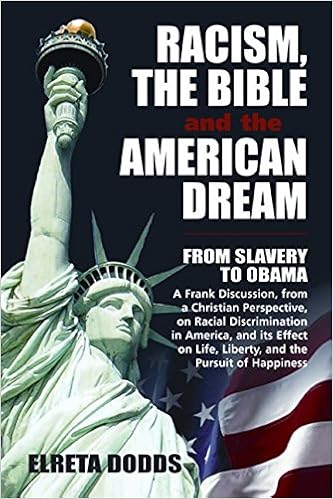
Author of “Racism, The Bible, and The American Dream”
Book Blog
Purchase Book from Amazon
12.02.14
Note: Anonymous comments not accepted.
Author of “Racism, The Bible, and The American Dream”
Book Blog
Purchase Book from Amazon
12.02.14
Note: Anonymous comments not accepted.
